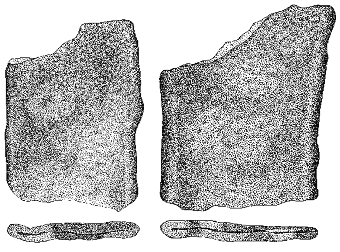
Fig. 3. Type specimens of D. latissima from Grzybowski's collection preserved in the Lvov Natural History Museum, Collection 10, nr. 15,253; from Vialov & Dabagian (1967). ORIGINAL DESIGNATION: Dendrophrya latissima Grzybowski, 1898. TYPE REFERENCE: Grzybowski, J., 1898. Otwornice pokładów naftonosnych okolicy Krosna. Rozprawy Wydziału Matematyczno-Przyrodniczego, Akademia Umiejętności w Krakowie, serya 2, vol. 33, p. 272, pl. 10, fig. 8. See also: Kaminski, M.A. & Geroch, S., 1993. A revision of foraminiferal species in the Grzybowski Collection. Grzybowski Foundation Special Publication, 1, 239-323, pl. 1. fig. 1a-c [Lectotype]. TYPE SPECIMEN: Not originally designated. The specimen corresponding to Grzybowski's original drawing and four smaller unfigured specimens are preserved in the Grzybowski collection, housed at the Jagiellonian University in Kraków (Grzybowski Collection no. UJ-132-P, 1/1). The lectotype designated by Kaminski & Geroch (1993; pl. 1, fig. 1) is Grzybowski's specimen figured in his pl. 10, fig. 8. Additional specimens from the Grzybowski collection housed at the Academy of Sciences in Lvov were illustrated by Vialov & Dabagian (1967). TYPE LEVEL: Paleogene, Silesian Unit of the Polish Carpathians. TYPE LOCALITY: Wisniowski well no. 1 at Toroszówka, 569 m, Krosno District, Poland. DIAGNOSTIC FEATURES: Test a wide, compressed tube with a thin, finely agglutinated wall. SIZE: Grzybowski reported specimens up to 7 mm in length and 2 mm in width. The types preserved in Lvov are up to 1.52 mm in width. SYNONYMS: None verified. OBSERVED OCCURRENCES: Nothia latissima is a common component of flysch-type assemblages. Grzybowski (1989, 1901) originally reported it from the Silesian and Magura Units of the Carpathian flysch deposits. It has subsequently been reported by Dylążanka (1923) from the Upper Cretaceous of the Magura Unit, by Grün et al. (1964) from the Upper Cretaceous Wienerwald flysch; Jurkiewicz (1967) from the Paleogene of the Carpathians in eastern Poland; Săndulescu (1972) from the Upper Cretaceous of the Tarcău Unit in Romania; and by Samuel (1977) from the Upper Cretaceous to Eocene of the Dukla and Magura Units in Slovakia. It is common in Eocene samples from the Hluk-4 Borehole in Moravia (see remarks under Praesphaerammina subgaleata). We have recorded it from the Paleogene of the Polish Carpathians, from the Paleocene of the Schlieren Flysch in Switzerland, the Lizard Springs Formation of Trinidad, Zumaya Spain, the Sub-Betic Unit of Southern Spain, and from the Campanian-Maastrichtian of DSDP Sites 141, 367, 368, and 386. We have not observed it in our samples from Scaglia-type assemblages from deep-water limestones, or in Upper Cretaceous assemblages from the abyssal plains. KNOWN STRATIGRAPHIC RANGE: Campanian to Paleocene. BATHYMETRY: Bathyal to abyssal. REMARKS: This species was originally placed in the genus Dendrophrya by Grzybowski (1898). We transfer it to the genus Nothia, because we have not observed a basal chamber or "center of attachment" (see remarks under Nothia excelsa). The specimen figured in our pl. 2, fig. 1 is the lectotype. ILLUSTRATIONS: Plate 3 - Nothia latissima (Grzybowski) Fig. 1. Lectotype from the Grzybowski Collection, Wisniowski well no 1,569 m, Toroszówka Poland. Length = 7.5 mm; Fig. 2. Paralectotype from the Grzybowski Collection, Wisniowski well no 1,569 m, Toroszówka Poland; Figs. 3, 4a,b. Majdan beds, Dukla Unit Polish Carpathians. 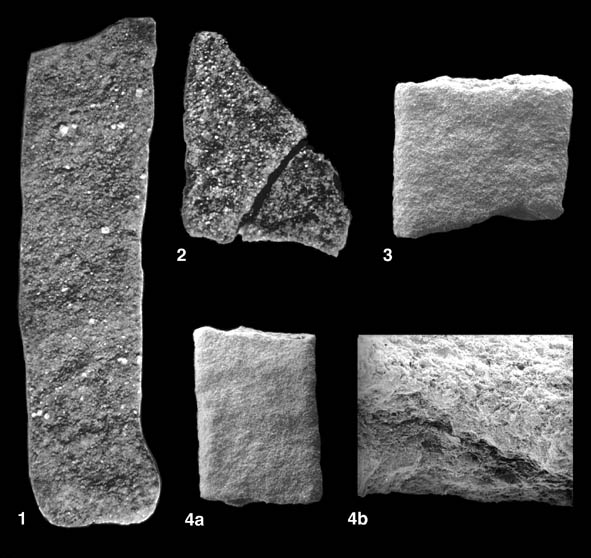
|