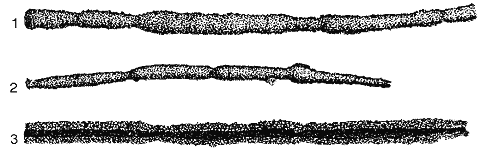
Fig. 5. 1-3. Type specimens of Rhabdammina discreta, from Brady (1884). Specimen #2 is the lectotype. ORIGINAL DESIGNATION: Rhabdammina discreta Brady, 1881. TYPE REFERENCE: Brady, H.B., 1881a. Notes on some of the reticularian Rhizopoda of the "CHALLENGER" Expedition; Part III. Quarterly Journal of Microscopical Sciences, 21, 31-71 TYPE SPECIMEN: Not originally designated. The specimens illustrated in Brady (1884) pl. 22, figs. 8-10 are deposited in the micropaleontological collections of the British Museum (Natural History). The lectotype specimen, designated herein, is the specimen illustrated by Brady in pl. 22, fig. 8. It is registered as ZF 4862 (ex slide ZF 2300). TYPE LEVEL: Recent. TYPE LOCALITY: Not originally designated. The lectotype specimen is from Porcupine station #4, 808 fathoms depth in the North Atlantic. The specimen in Brady's pl. 22, fig. 9 (BMNH Slide ZF 2301) is from Porcupine station #19, 630 fathoms depth, collected northwest of Ireland. The specimen in pl. 22, fig. 10 (BMNH Slide ZF 2302) is from Valorous station #5, 410 fathoms depth in the Pacific. DIAGNOSTIC FEATURES: Test straight, non-branching, with annular constrictions at irregular intervals, but no internal partitions or central inner chamber. The largest specimens may have as many as five constrictions. The tube may taper towards one end. The wall is comprised of mineral grains (mostly quartz) several grains thick and firmly cemented. Cement is an organic foam. The grain size of agglutinated material is variable. Apertures at the open end of the tube. SIZE: Variable. Brady (1881) reported specimens up to 1 inch in length. The syntype specimen in Brady's pl. 22, fig. 7 is 6 mm long and 0.28 mm wide, with constrictions spaced ~1.5 mm apart. The other co-type specimens are up to 18 mm in length. The paralectotype specimens from the Pacific are up to 0.40 mm in width. Parr (1950) reported specimens with a length up to 30 mm near Antarctica. SYNONYMS: Rhabdammina subdiscreta Grzybowski. Grzybowski, J., 1896, Rozprawy Wydziału Matematyczno-Przyrodniczego, Akademia Umiejętności w Krakowie, serya 2, vol. 30, p. 275, pl. 8, figs. 5,6.[Paleogene, Polish Carpathians]. OBSERVED OCCURRENCES: Psammosiphonella discreta is common throughout the modern ocean and occurs as fossils in flysch-type and abyssal assemblages. Brady (1884) reported it as Rhabdammina discreta from seven stations in the North Atlantic, two stations in the South Atlantic, four stations in the south Pacific and from a single station in the western Pacific. Cushman (1918) recorded it at numerous stations in the western North Atlantic from 410 to 2045 fathoms. In the area of the Philippines, Cushman (1921) listed it from 221 to 985 fathoms. Earland (1934) listed it from 10 stations in the Southern Ocean, noting it was generally rare. Pflum (1966) recorded it from stations shallower than 668 m in the eastern Ross Sea and Bellingshausen Sea. KNOWN STRATIGRAPHIC RANGE: Cretaceous to Recent. BATHYMETRY: Outer neritic to abyssal, most common on the continental slope. REMARKS: The genus Rhabdammina (type species R. abyssorum Brady) as defined by Loeblich & Tappan (1987) includes forms consisting of a swollen central cavity with three to five radiating arms of nearly constant diameter and a thick agglutinated wall. Forms comprised of a central cavity with two arms (R. linearis Brady) were assigned to the genus Oculosiphon Avnimelech, 1952. The genus Psammosiphonella Avnimelech, 1952 [type species Bathysiphon arenacea Cushman, 1927] was originally set up to include undivided tubular forms with no central cavity and with a thick wall comprised of mineral grains, but Loeblich & Tappan (1987) synonymised the genus with Bathysiphon. As defined by Loeblich & Tappan (1987), none of the genera in the family Rhabdammininae can accommodate the species R. discreta Brady. Cicha et al. (1998) reinstated the genus Psammosiphonella Avnimelech, 1952 to accommodate undivided tubular forms without a central cavity. These authors upheld the original distinction between Psammosiphonella and Bathysiphon, which Avnimelech (1952) regarded as having a wall containing a significant proportion of sponge spicules. Avnimelech (1952) originally assigned R. discreta Brady to his genus Psammosiphonella. ILLUSTRATIONS: Plate 5 - Psammosiphonella discreta (Brady) Figs. 1-3. Recent, Paralectotypes, North Atlantic, Porcupine Sta. #4, 808 fathoms. BMNH nos ZF 4863-4865; Fig. 4. Recent, Paralectotype, North Atlantic, Porcupine Sta. #4, 808 fathoms. BMNH no. ZF 4866; Fig. 5. Campanian, Labrador Margin, Indian Harbour M-52 well 10,750-780'; Fig. 6. Early Eocene, ODP Site 643, Norwegian-Greenland Sea, Sample 643A-57R-3, 77-81 cm; Fig. 7. Eocene, Central North Sea, Phillips 16/29-2x well, 6920'; Fig. 8. Maastrichtian, Labrador Margin, North Leif I-05 well 2610-2620 m; 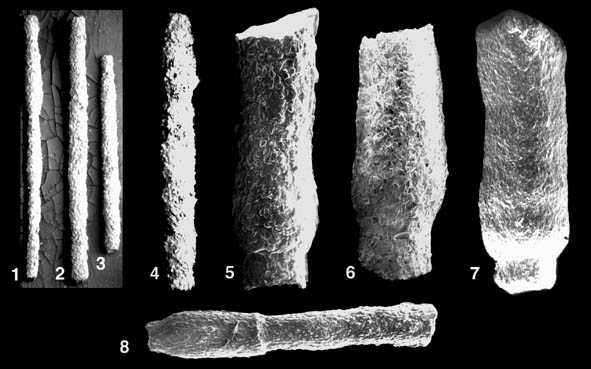
|