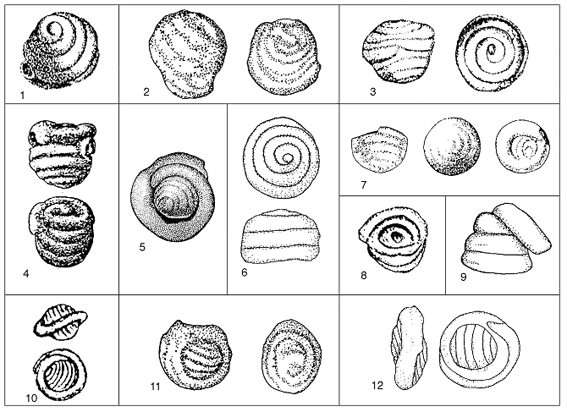
Fig. 22. Subjective synonyms of Glomospira charoides (Jones & Parker). All drawings are of holotypes or type figures. 1 - Earliest figure of G. charoides, from Carpenter et al. (1862). 2 - type specimens of G. subarctica, redrawn after Chamney (1969), 3 - type figure of G. praecharoides, redrawn after Soliman (1972), 4 - type figures of G. charoides corona, after Cushman & Jarvis (1928), 5 - holotype of G. charoides antarctica, from Saidova (1975), 6 - holotype of G. favilla, redrawn after Emiliani (1954), 7 - type specimens of G. pileolus, from Subbotina (1960), 8 - holotype of G. charoides leroyi, from Said & Kenawy (1956), 9 - holotype of G. charoides profunda, redrawn after Saidova (1975), 10 - holotype of G. saturniformis, from Majzon (1943), 11 - type specimens of G. subarctica saturna, redrawn after Chamney (1969), 12 - type specimen of G. charoides extendens, after Emiliani (1954). ORIGINAL DESIGNATION: Trochammina squamata var. charoides Jones & Parker, 1860. TYPE REFERENCE: Jones, T.R. & Parker, W.K. 1860. On the Rhizopodal fauna of the Mediterranean compared with that of the Italian and some other Tertiary deposits. Quarterly Journal of the Geological Society of London, 16, 292-307 [no type figure given]. See also: Carpenter et al. 1862. Ray Society, London, pl. 11, fig. 4 [earliest figure]; Berggren, W. A. & Kaminski, M. A., 1990, NATO ASI Series C327, pl. 1, fig. 2 (lectotype). TYPE SPECIMEN: Deposited in the micropaleontological collections of the British Museum (Natural History). Four slides containing syntypes forming part of the Parker Collection, were purchased by the British Museum in 1892 and were subsequently catalogued by T.R. Jones. These slides are registered as follows: TYPE LEVEL: Recent. TYPE LOCALITY: Not originally designated. Jones & Parker (1860) listed several stations in the Greek archepelago and off Crete. The lectotype specimen is from a dredge sample collected on Oct. 3, 1859 aboard the HMS Firebrand, from a depth of 704 fathoms 33 mi SE of Cape Demitri, Gozo Island, Malta (36° 18'N, 13° 33'E). DIAGNOSTIC FEATURES: Test free, proloculus followed by a trochospirally enrolled, undivided tubular second chamber, coiled about a vertical axis. The test is comprised of about three layers of coils, and there are typically six or seven whorls in the outermost layer. The last whorl may deviate from the axis of coiling, and be inclined to the axis, loop-shaped, or irregular. Wall finely agglutinated, cemented with undifferentiated organic mater, with inner and outer organic linings, and a smooth surface. Aperture at the open end of the tube. SIZE: Diameter ranges up to .40 mm. The lectotype specimen is .27 mm in diameter. SYNONYMS: Glomospira charoides (Jones & Parker) var. corona Cushman & Jarvis. Cushman, J.A. & Jarvis, P.W. 1928, Contr. Cushman Lab. Foram. Res., 4:89, pl. 12, figs. 9-11 [Paleocene, Trinidad]. Glomospira saturniformis Majzon. Majzon, L. 1943, Magyar K. Foldt. Int. Evk., Budapest 37: 31, pl. 5, fig. 9 [Late Cretaceous, Carpathians]. Glomospira charoides (Jones & Parker) var. extendens Emiliani. Emiliani, C. 1954, Paleontogr. Italica 48: 133, pl. 13, fig. 14a-c [Oligocene, Appennines]. Glomospira favilla Emiliani. Emiliani, C. 1954, Paleontogr. Italica B>48:133, pl. 13, fig. 15a-c [Oligocene, Apennines]. Glomospira charoides (Jones & Parker) var. leroyi Said & Kenawy. Said, R. & Kenawy, A. 1956, Micropal. 2:120, pl. 1, fig. 6 [Paleocene, Egypt]. Glomospira subcharoides Khalilov. Khalilov, D.M. 1959. Izvest. Akad. Nauk. Azerbaidzhan. SSR, Ser. geol.-geogr. nauk, 6, p. 25, pl. 1, fig. 1a-c. [Valanginian, Azerbaidzan]. Glomospira subcharoides var. sphaera Khalilov. Khalilov, D.M. 1959. Izvest. Akad. Nauk. Azerbaidzhan. SSR, Ser. geol.-geogr. nauk, 6, p. 27, pl. 1, fig. 1d. [Hauterivian, Azerbaidzan]. Glomospira charoides (Parker & Jones) var. minima Subbotina. Subbotina, N.N. 1960, Trudy VNIGRI 153 , p. 179, pl. 1, figs. 11a-12b [Early Miocene, Ukraine]. Glomospira pileolus Subbotina. Subbotina, N.N. 1960, Trudy VNIGRI 153, p. 179, pl. 1, figs. 13a-14c [Early Miocene, Ukraine]. Glomospira iranensis Kavary. Kavary A. & Frizzel, D. 1963, Missouri Univ. School of Mines & Metal. Bull. 102:10, pl. 1, figs. 2-7 [Paleocene, Iran]. Glomospira subarctica Chamney. Chamney, T.P. 1969, GSC Bull 185, p. 16, pl. 2, figs. 7-9 [Barremian, Mackenzie District, N.W.T.]. Glomospira subarctica saturna Chamney. Chamney, T.P. 1969, GSC Bull 185, p. 17, pl. 2, figs. 10-12. [Barremian, Mackenzie District, N.W.T.]. Glomospira praecharoides Soliman. Soliman, H.A. 1972. Revue de Micropal. 15, p. 36, pl. 1, figs. 1, 2; pl. 2, fig. 1 [Cenomanian, Carpathians]. Usbekistania charoides antarctica Saidova. Saidova, Kh. 1975, p. 71, pl. 96, fig. 3 [Recent, Pacific]. Usbekistania charoides profunda Saidova. Saidova, Kh. 1975, p. 71, pl. 18, fig. 5 [Recent, Pacific]. Glomospira fulgida Maslun. Maslun, N.V. 1987, Paleont. Sbornik, 24, p. 69, pl. 2, fig. 3 [Eocene, Carpathians]. OBSERVED OCCURRENCES: Glomospira charoides is a cosmopolitan species in the modern ocean, and is present in Cretaceous to Paleogene slope, flysch-type, and abyssal assemblages. It is the dominant species of Glomospira in Cretaceous and Paleogene abyssal assemblages. However, we did not find G. charoides in our box core and gravity core samples collected on the Hatteras and Nares Abyssal Plains (Glomospira gordialis is the only species of Glomospira present in these samples). Glomospira charoides occurs in low numbers along the Nova Scotian Continental Slope and Rise between 2225 and 4815 m (Schröder, 1986). KNOWN STRATIGRAPHIC RANGE: Jurassic to Recent. BATHYMETRY: Bathyal to abyssal in Cretaceous to Paleogene assemblages. May be restricted to the Continental Slope and Rise in the modern Atlantic. In the Gulf of Gascony (eastern Atlantic), Pujos-Lamy (1973) reported its upper depth limit at 1,975 m, coincident with that of Melonis pompilioides. In the Gulf of Mexico it occurs at shallower depths; Pflum & Frerichs (1976) reported its upper depth limit at around 100 m. There are reports of G. charoides on the continental shelf at high latitudes. Balkwill & Wright (1885) illustrated a specimen from 24 fathoms off Kish Bank, Ireland. REMARKS: Glomospira charoides was designated the type species of the genus Repmanina by Suleymanov (in Arapova & Suleymanov, 1966), and this genus was considered valid by Loeblich & Tappan (1988). Loeblich & Tappan defined Repmanina as follows: "Test free, proloculus followed by elongate tubular undivided second chamber that is trochospirally coiled about a straight axis; wall finely agglutinated; aperture at the open end of the tubular chamber." The mode of coiling described by Suleymanov has been confirmed by cross-sections of G. charoides and G. gordialis published by Bender (1995; pl. 3; fig. 1), which shows that a typical specimen possesses three layers of trochospirally enrolled chambers. The proloculus is surrounded by four volutions of the chamber; in the final volution, six coils are present. These sections demonstrate that both species are congeneric [see remarks under Glomospira gordialis]. 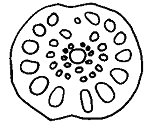
Fig. 22-2. Lateral cross section of G. charoides, showing the volutions of the chamber and mode of coiling. Redrawn from Bender (1995) Numerous junior synonyms or subspecies of Glomospira charoides have been described in the literature (Figure 22-1), and some of these morphotypes may be assigned to different genera according to Loeblich & Tappan (1987). In some individuals, the tubular chamber may abruptly change coiling direction or become irregular near the end of the tube. Cushman (1918) noted in his description of G. charoides that the tubular chamber turns "at right angles to the preceeding axis and makes a partial or even complete revolution about the earlier formed globular test". Nevertheless, subsequent authors have described specimens which display this feature as different species. The Paleocene species Usbekistania mubarekensis Suleymanov is the equivalent of a G. charoides with two or more planispiral whorls oriented in the plane of the vertical axis. We have observed rare specimens of G. charoides with the last whorl oriented 90° to the previous set of whorls in the Eocene of the Atlantic and in the Cretaceous of the Indian Ocean, but in each case there is less than one whorl. Therefore, Usbekistania mubarekensis may be a geographically restricted decendant of G. charoides, and is probably taxonomically distinct. The following is a list of varieties and subspecies of G. charoides that have been described in the literature:
Other unnamed varients of the coiling plan also occur in fossil assemblages alongside "normal" specimens of Glomospira charoides. These varients include the following:
Of the above list of species and varieties, we regard G. charoides antarctica, G. charoides profunda, G. iranensis, G. praecharoides, and G. subarctica to be fully synonymous outright. The other named and unnamed forms are various ontogenic or geriatric growth stages which occur naturally in any large population. For example, in a single sample from the Eocene of the Polish Carpathians, we found specimens corresponding to the "charoides","corona", "favilla", "extendens" or "saturniformis" and unnamed morphotypes 2, 3, and 4. Specimens from this sample are illustrated in pl. 22, figs. 2-7. Another suite of specimens from the Lower Cretaceous of the Indian Ocean is shown in pl. 22, figs. 13-16. ILLUSTRATIONS: Plate 22 - Glomospira charoides (Jones & Parker) Fig. 1. Recent, Gozo Island 704 fathoms, Lectotype, Parker Collection, BMNH no. ZF 4875, ex Slide 1894.4.3.540; Fig. 2-7. Early Eocene, Szklary Poland, Skole Unit of the Polish Carpthians. All specimens from a single sample. fig. 2 - G. charoides charoides morphotype; fig. 3 - "Glomospira favilla" or "Glomospira pileolus" morphotype; fig. 4 - "Glomospira charoides corona" morphotype; fig. 5 - unnamed morphotype #2, with inclined last whorl; fig. 6 - "Glomospira charoides extendens" morphotype; fig. 7 - unnamed morphotype # 4, with irregular tube end; Fig. 8. Early Eocene, ODP Site 647, Labrador Sea, "Glomospira charoides extendens" morphotype; Fig. 9-12. Late Cretaceous, DSDP Site 137, Eastern Atlantic Abyssal Plain. fig. 9 - the equivalent of "Glomospira praecharoides"; fig. 10 - unnamed morphotype # 3, with a looped last whorl; fig. 11 - unnamed morphotype # 4, with irregular tube; fig. 12 - unnamed morphotype # 1, with a tube that doubles back 180°; Fig.13-16. Early Cretaceous, ODP Site 765, Argo Abyssal Plain. fig. 13 - the equivalent of "Glomospira subarctica"; fig. 14 - "Glomospira subarctica" with inclined last layer of whorls; fig. 15 - "Glomospira subarctica" with inclined last layer of whorls; fig. 16 - the equivalent of "Glomospira subarctica saturna" or "Glomospira saturniformis". 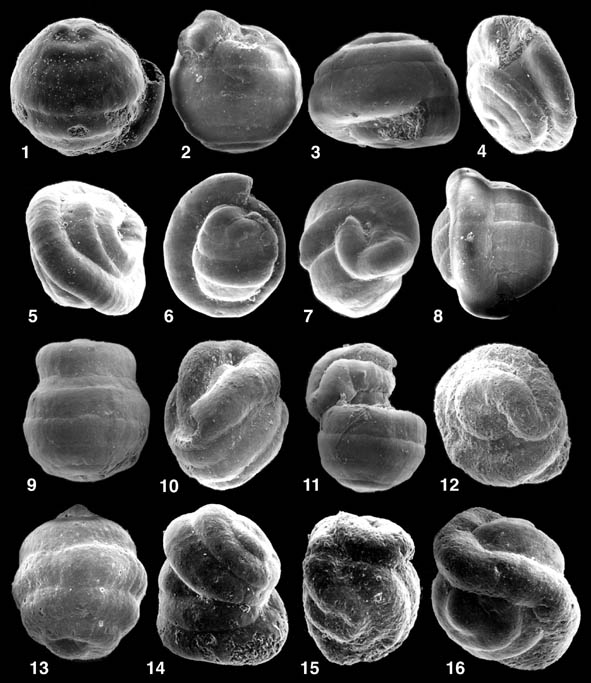
|