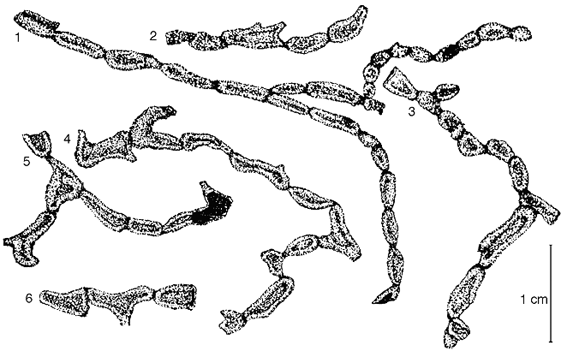
Fig. 38. Type figures of A. carpathica, from Neagu (1964). Specimen #1 is the holotype, all others are paratypes ORIGINAL DESIGNATION: Aschemonella carpathica Neagu, 1964 TYPE REFERENCE: Neagu, T., 1964. Duze otwornice aglutynujące z kampanu karpat rumunskich. Rocznik Polskiego Towarzystwa Geologicznego, 34, 579-588, p.582, pl.27, figs. 1-3; textfig. 1, 5-8; textfig 2, 2-4; textfig. 3, 1-3; textfig. 4, 1-6. TYPE SPECIMEN: Housed at the Laboratory of Paleontology, University of Bucharest, Romania. Holotype is registered as specimen LPB 5002. TYPE LEVEL: Upper Campanian, G. calcarata biozone, internal flysch zone of the Eastern Carpathians. TYPE LOCALITY: Ulveş Valley, Braşov County, Romania. DIAGNOSTIC FEATURES: Test free, moniliform, articulated, dichotomously branched, consisting of numerous round, oval or elongate chambers increasing gradually in size. Test wall is comprised of quartz, mica flakes, sponge spicules, with abundant cement. Apertures circular, situated on small necks at the end of the terminal chamber or along the sides SIZE: Neagu reported specimens up to 7 cm in length and 1 to 3 mm in width. SYNONYMS: Aschemonella sp. Geroch, S., 1960. Inst. Geol. Biul. 153, p. 41, pl. 1, figs. 24, 25. [by original designation]. OBSERVED OCCURRENCES: Aschemonella carpathica was originally reported from the Campanian of the Romanian Carpathians by Neagu (1964), where whole specimens are preserved on the underside of sandstone beds. Neagu (1970) subsequently reported it from the Campanian of the Eastern Carpathians in Romania. It was reported by Geroch (1960) as Aschemonella sp from the Paleocene Ciężkowice Beds of the Silesian Unit of the Polish Carpathians. Vialov (1966) listed it from the Senonian of the Dukla Unit of the Ukrainian Carpathians. Hanzlíková (1972) listed it from the Istebna and Solan beds (Campanian-Paleocene) of the Silesian Unit of the Carpathians in Moravia. Jednorowska (1975) reported it from the Paleocene of the Silesian, Dukla, and Magura Units of the Polish Carpathians. Kuhnt (1987) reported it from the Almarchal Series of southern Spain. Milner (1997) illustrated a specimen (as Aschemocella sp.) from the Paleocene Moogli Mudstone of Papua New Guinea. KNOWN STRATIGRAPHIC RANGE: Late Cretaceous to lower Eocene. BATHYMETRY: Bathyal to upper Abyssal. REMARKS: We assign this form to the genus Aschemocella Vialov 1966 (type species Aschemonella carpathica), following the usage of Loeblich & Tappan (1987). Modern representatives of the genus Aschemonella have been shown to be xenophyophores (Gooday & Nott, 1982) and therefore this name is not available. Although Aschemocella was originally set up by Vialov for forms with a primary siliceous wall, the genus was reinstated by Loeblich & Tappan (1987) for fossil forms which may be foraminifera. ILLUSTRATIONS: Plate 38 - Aschemocella carpathica (Neagu) Fig. 1-2. Campanian, Topotype from the Ulveş Valley, Braşov County, Romania; Fig. 3-4. Maastrichtian, Talaa Lakrah Flysch, Morocco; Fig. 5. Campanian, Almarchal Unit, Campo de Gibraltar, southern Spain. 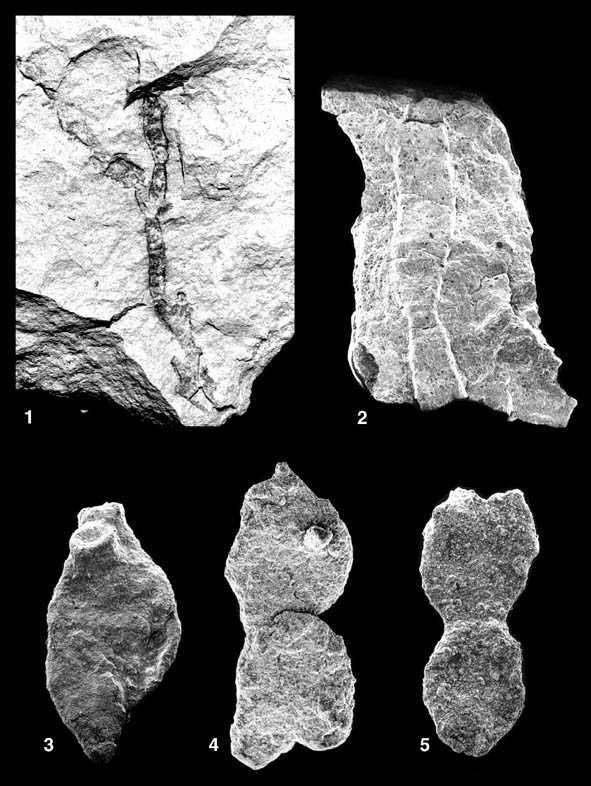
|