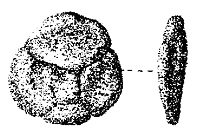
Fig. 68. Type figure of T. variolarius, from Grzybowski (1898) ORIGINAL DESIGNATION: Trochammina variolaria Grzybowski, 1898. TYPE REFERENCE: Grzybowski, J., 1898. Otwornice pokładow naftonośnych okolicy Krosna. Rozprawy Wydziału Matematyczno-Przyrodniczego, Akademia Umiejętności w Krakowie, serya 2, vol. 33, p. 288, pl. 11, fig. 15. See also: Kaminski, M.A. & Geroch, S., 1993. A revision of foraminiferal species in the Grzybowski Collection. Grzybowski Foundation Special Publication, 1, 239-323, pl. 9. fig. 5a,b [Lectotype]. TYPE SPECIMEN: Not originally designated. The specimen figured by Grzybowski is not preserved in the collection, but an unfigured syntype (pl. 88, fig. 1a-b) is registered as UJ-132-P 1/61a-d. This specimen was designated the lectotype by Kaminski & Geroch (1993). TYPE LEVEL: Eocene, Silesian unit of the Polish Carpathians. TYPE LOCALITY: Not originally designated. Grzybowski (1898) reported this species from 16 different exploration wells drilled near Krosno Poland. The lectotype is from the Potok H-34 well, 290 m. DIAGNOSTIC FEATURES: Test small, comprised of two whorls, with four chambers in the last whorl, quadrate in outline. Coiling planispiral or low trochospiral. Chambers increase in size rapidly, are somewhat elongate, but increase in diameter towards the middle. Wall finely agglutinated, with a smooth surface. Test is usually compressed. SIZE: Diameter of lectotype: 0.78 mm. SYNONYMS: None verified. OBSERVED OCCURRENCES: Trochamminoides variolarius (Grzybowski) was originally described by Grzybowski (1898) from the Paleogene of the Silesian Unit of Polish Carpathians. It was subsequently reported by Grzybowski (1901) and Dylążanka (1923) from the Inoceramus beds of the Magura Unit. Jednorowska (1968) reported it as Trochammina variolaria from the Paleogene Inoceramus beds and variegated claystones of the Magura Unit, and Bąk (2004) illustrated it from the upper Maastrichtian Cisna Beds and the upper Paleocene Hieroglyphic Beds of the Dukla Unit in the Polish Carpathians. Grün et al. (1964) and Grün (1969) reported it from the Maastrichtian of the Vienna flysch. Săndulescu (1973) listed it from the Senonian Horgazu Beds of the Romanian Carpathians. KNOWN STRATIGRAPHIC RANGE: Late Cretaceous to Eocene. BATHYMETRY: Bathyal to abyssal. REMARKS: This species is distinguished from other species of Trochamminoides in the rounded-triangular shape of its chambers, and in having few whorls. Unfortunately, the specimen figured by Grzybowski is not preserved in the collection. Of the four remaining vials labelled "T. variolaria" in the collection, one is empty and two contain only indeterminate fragments. The single remaining syntype is shown in Plate 92, fig. 1a,b. Grzybowski mentioned that his specimen had only one chamber visible in the center. Our specimens typically have between one and three chambers visible in the umbilical region. ILLUSTRATIONS: Plate 68 - Trochamminoides variolarius (Grzybowski) Fig. 1a,b. Lectotype from the Grzybowski Collection, Potok H-34 well, 290 m; Fig. 2. Lower Eocene, Variegated Shales, Magura Unit of the Polish Carpathians; Fig. 3. Lower Eocene, Szklary Poland, Skole Unit of the Polish Carpathians; Fig. 4. Paleocene, Szklary Poland, Skole Unit of the Polish Carpathians; Fig. 5. Maastrichtian, Talaa Lakrah Unit of northern Morocco; Fig. 6. Lower Eocene, Celebes Sea Site 767, Sample 767C-11R-1, 54-57 cm; Fig. 7. Paleocene, Talaa Lakrah Unit of northern Morocco; Fig. 8. Maastrichtian, Talaa Lakrah Unit of northern Morocco. 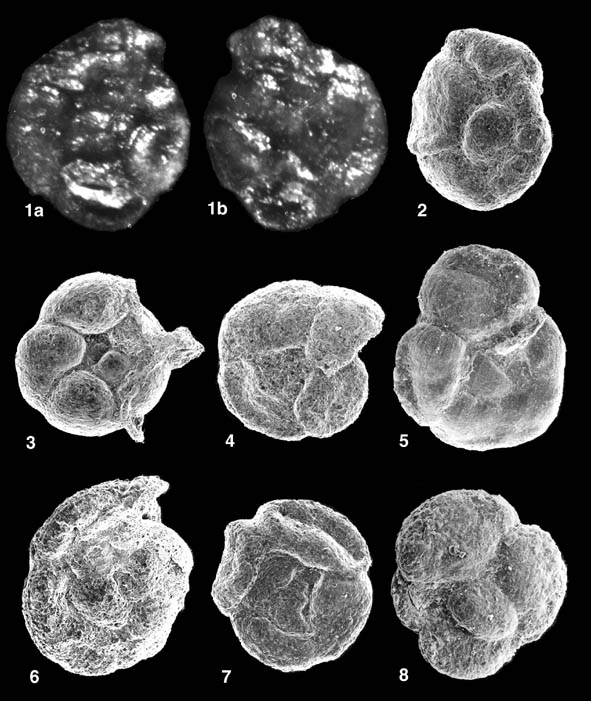
|