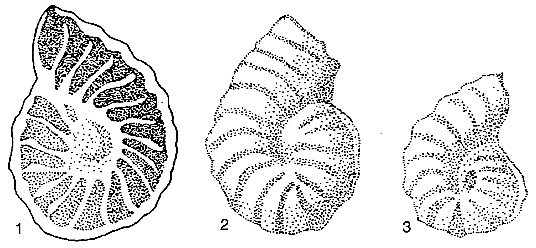
Fig. 72-1. Type specimens of A. aubertae, from Gradstein & Kaminski (1989). 1- Holotype, 2,3- Paratypes ORIGINAL DESIGNATION: Ammomarginulina aubertae Gradstein & Kaminski TYPE REFERENCE: Gradstein, F.M., & Kaminski, M.A., 1989. Taxonomy and biostratigraphy of new and emended species of Cenozoic deep-water agglutinated foraminifera from the Labrador and North Seas. Micropaleontology, 35 (1), p.74, pl. 3, figs. 1-8, pl. 4, figs. 1-3; textfigure 2. TYPE SPECIMEN: Holotype (USNM 429109) and several paratypes (USNM 429110) have been deposited in the micropaleontological collections of the U.S. National Museum, Washington, D.C. Additional specimens (metatypes) are deposited at the Natural History Museum in Vienna Austria (MI-617 and MI-618); at the Jagiellonian University in Kraków Poland, and in the authors' collections. TYPE LEVEL: Early to Middle Eocene. TYPE LOCALITY: Central North Sea, UK Blocks 22 and 30. Holotype is from the Shell 30/19-1 well, 8727-9106 ft. Figured paratypes are from the Shell 22/6-1 well, 6356-6820 ft. DIAGNOSTIC FEATURES: Test free, initial part consisting of an evolute planispiral coil of more than one whorl, with an open umbilicus and coil suture, with 10 to 18 chambers in the last whorl (average 14). Sutures are slightly depressed and may be slightly curved or sigmoidal in the planispiral part. In well-preserved specimens, sutures stand out as dark lines when viewed on a dark background. The periphery is rounded and may be slightly lobate at the sutures. Chambers increase in size slowly. The uncoiled part of the test, when present, is usually short and extends tangentially from the coiled part in the plane of coiling. The sutures in the uniserial part are generally oblique and are flush with the surface of the test. In some specimens the uncoiled part is situated assymetrically atop the planispiral part. In this case, the chambers may be uniserial or may be arranged in a staggered manner, suggesting biseriality. The apertural face may be flat or slightly convex and is oval in outline. The aperture in the spiral part is areal and raised on a short neck at the top of the apertural face. As a result, the chambers in the spiral part are connected by a U-shaped tube which is expressed on the exterior as a peripheral lobe. This lobe may possess a bulbous swelling. Aperture in the uncoiled portion is terminal, at the dorsal side of the apertural face. Wall medium to finely agglutinated with much cement. Agglutinated grains are mostly quartz. SIZE: (Holotype) Length 0.37 mm; width 0.26 mm; height of chambers 0.03 mm. Length of largest specimen in our collections: 0.60 mm. SYNONYMS: Ammobaculites aff. polythalamus Loeblich. Gradstein, F.M., & Berggren, W.A., 1981. Marine Micropaleontology, 6, p. 253, pl. 4, figs. 6-8 [Paleogene, North Sea; Labrador Sea]. OBSERVED OCCURRENCES: Ammomarginulina aubertae is typically a high-latitude species largely restricted to the North Sea, Labrador Margin, western Barents Sea, and the Arctic Ocean. It was recorded as Ammobaculites aff. polythalamus from the Upper Paleocene to Middle Eocene of the Central North Sea by Gradstein & Berggren (1981), where we have confirmed it to range from Zone NSR2, Late Paleocene to Zone NSR6, late Middle Eocene. In Labrador Margin wells, it ranges from the A. mayaroensis Zone, Late Maastrichtian to Zone LGR6, Late Eocene. D'Iorio (1986) determined its average last occurrence at ca. 40 Ma on the Labrador Margin. In the Canadian Arctic, it was recorded as "Ammomarginulina sp. aff. A. foliaceus" by Young & McNeil (1983). In the Beaufort-MacKenzie Basin, it ranges from Late Eocene to Late Miocene (Schröder-Adams & McNeil, 1994), where it is common in the Richards sequence, and rare in the Kugmallit sequence. Speijer (1994) reported it from the basal Paleocene agglutinated facies of the K/T boundary type section at El Kef, Tunisia. We have observed this species in both Speijer's samples as well as in other samples from El Kef in the collections of R. Coccioni (Univ. Urbino). This species is also observed in authochthonous Eocene sediments that occur as incised valley fills on the southeastern flank of the Bohemian Massif in Moravia. We have verified its occurrence in borehole samples housed in the collections of the Moravian Oil Company. We have also observed rare specimens of the species in the lower Eocene of the Western Barents Sea (Nagy et al., 1997). Despite our efforts to locate this species at other localities, we have not observed it in our samples from DSDP sites, Trinidad, or from the Carpathian flysch deposits. KNOWN STRATIGRAPHIC RANGE: Maastrichtian to Miocene. The last occurrence of this taxon is a useful indicator of Middle Eocene strata in the North Sea and Late Eocene strata in the Labrador Sea. BATHYMETRIC RANGE: Outer neritic to bathyal REMARKS: Specimens of A. aubertae with well-developed uniserial portions, such as those illustrated in Plate 54a, are rare. Accordingly, our choice of a holotype specimen reflects the type of specimen that is commonly encountered. This specimen has at most one uniserial chamber. Specimens from the Maastrichtian and Paleocene of the Labrador Margin have an average of 12 chambers in the last whorl of the planispiral part. We have not observed any specimens with well-developed uniserial portions in our material from the Labrador Margin. The specimens from Labrador also have coarser material incorporated into the wall than specimens from the North Sea. As a consequence, their exterior morphology is more irregular and their internal structure is less distinct. Although the Labrador specimens also occur in stratigraphically older horizons, we do not believe the differences in morphology are sufficiently great to warrent the creation of subspecies. 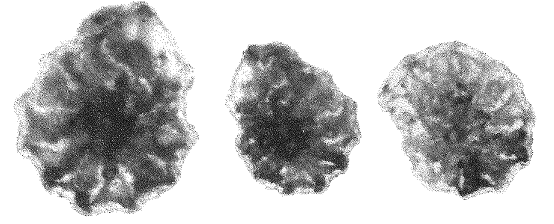 Fig. 72-2. Specimens of A. aubertae from the collections of the Moravian Oil Company, scanned from a transmitted light photograph (courtesy of M. Bubík). ILLUSTRATIONS: Plate 72a - Ammomarginulina aubertae Gradstein & Kaminski Figs. 1a,b. Eocene, North Sea, UK Block 30, Shell 30/19-1 well, Holotype; Figs. 2-7. Eocene, North Sea, UK Block 22, Shell 22/6-1 well 6356 - 6820', Paratypes. 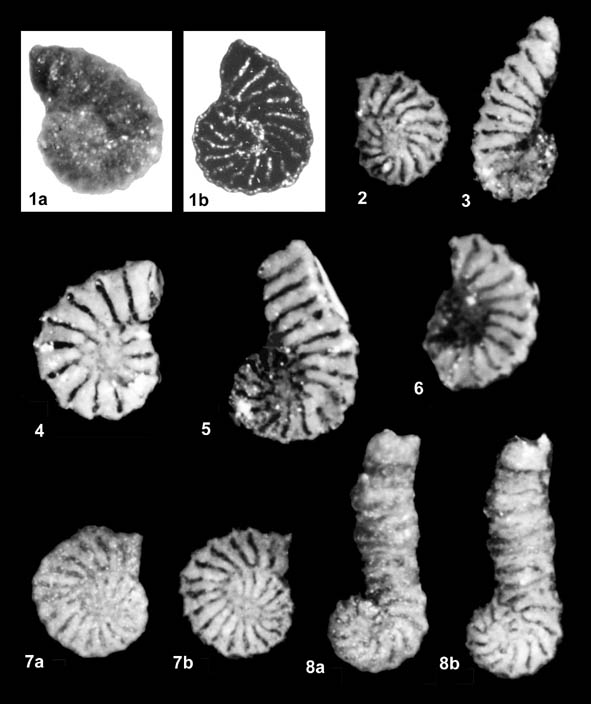
Plate 72b - Ammomarginulina aubertae Gradstein & Kaminski Fig. 1a,b. Paleocene, Labrador Margin, North Leif I-05 well, 2495 m, metatype; Fig. 2a,b. Eocene, Grand Banks, Flying Foam well, 4500-6400 ft. metatype; Fig. 3a,b. Paleocene, Labrador Margin, Indian Harbour M-52 well, 10,450 ft. metatype. 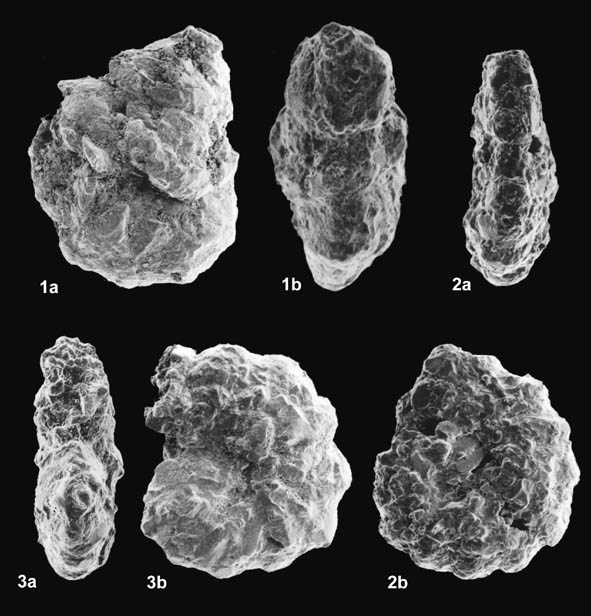
|