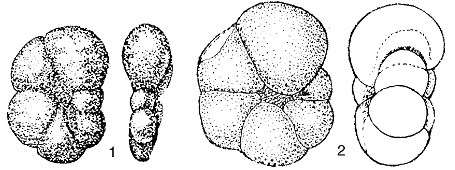
Fig. 79. 1 - Holotype of H. porrectus from Maslakova (1955); 2- Specimen from Czechoslovakia, from Samuel (1977) ORIGINAL DESIGNATION: Haplophragmoides porrectus Maslakova, 1955 TYPE REFERENCE: Maslakova, N.I., 1955. Stratigrafia i fauna melkikh foraminifer paleogenovykh otlozhenii vostochnykh Karpat. In: Bogdanov, A.A. (ed), Materialy po Biostratigrafii zapadnykh oblastey Ukrainskoy SSR. Gosgeoltekhizdat (Moscow), 5-131. TYPE SPECIMEN: Originally housed in the Geology Museum of the Geologo-Razvedochniy Institute in Moscow. The holotype, registered as specimen no. 6-92/15, is missing from the collections and is presumed lost. TYPE LEVEL: Paleocene, Jamnenskaya Svita, Ukrainian Carpathians. TYPE LOCALITY: Not given. DIAGNOSTIC FEATURES: Test small, planispiral, round in outline, elongated, comprised of two whorls. The initial whorls visible only in immersion. Diameter of the initial whorls is one-third the diameter of the last whorl. The chambers of the initial whorls are much smaller than the chambers of the final whorl. The last whorl is comprised of six triangular chambers. Wall finely agglutinated with a smooth surface. Aperture slit-like, located at the base of the last chamber. SIZE: Small. Type specimens were reported as 0.18 to 0.28 mm in diameter. SYNONYMS: None verified. OBSERVED OCCURRENCES: Maslakova (1955) originally reported H. porrectus from the Paleogene of the Ukranian Carpathians. De Klasz & De Klasz (1990) illustrated a specimen from the Danian of the Buntmergelserie, Ultrahelvetic Unit, in Bavaria. Webb (1975) illustrated a specimen as Haplophragmoides kirki from the Paleocene of DSDP Site 283 in the Tasman Sea. Samuel (1977) reported it in the Upper Paleocene and Lower Eocene part of the Submenilite and Beloveza Beds in Czechoslovakia. Bąk (2004) illustrated specimens from the upper Paleocene - Lower Eocene of the Dukla Unit in Poland. KNOWN STRATIGRAPHIC RANGE: Paleocene to Eocene. BATHYMETRY: Bathyal to Abyssal. REMARKS: Transitional forms exist between H. porrectus and Recurvoidella lamella. These forms have 5 1/2 chambers in the last whorl. Specimens of H. porrectus from the Paleogene of the Labrador Margin have as many as 7 chambers in the last whorl. ILLUSTRATIONS: Plate 79 - Haplophragmoides porrectus Maslakova Figs. 1a,b. North Sea, Conoco 211/19-1 well, 5840'; Figs. 2a-3. Labrador Margin, Indian Harbour M-52 well, 10450-10660 ft; Figs. 4a-5b. Lower Eocene, ODP Site 643, Norwegian Sea, Sample 643A, 62X-1, 77-81 cm; Fig. 6. Paleocene, Lizard Springs Formation of Trinidad. 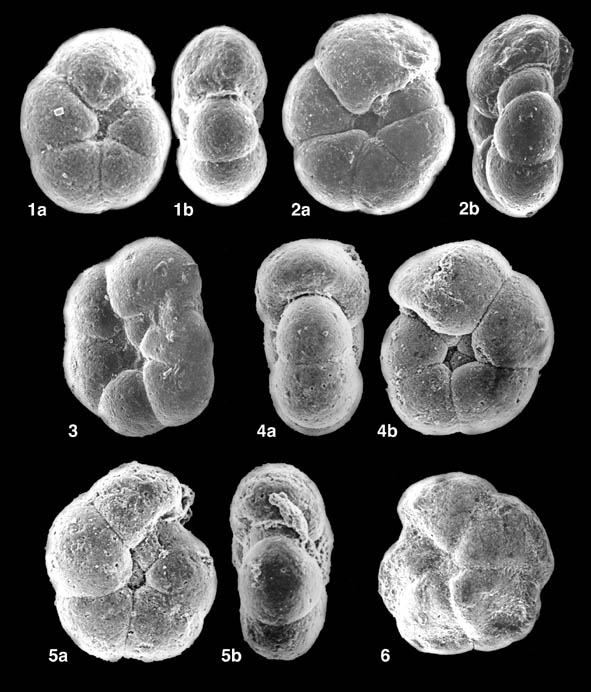
|