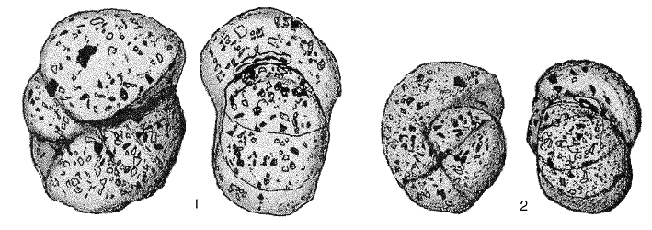
Fig. 92-1. Syntypes of "Haplophragmoides subglobosum" from the Cushman Collection (plesiotypes of Cushman, 1910), from ALBATROSS Sta. D3603. 1- lectotype, USNM 8219b; 2- paralectotype, USNM 8219a. Camera lucida drawings. ORIGINAL DESIGNATION: Lituola subglobosa M. Sars, 1869 (nomen nudum). Haplophragmoides subglobosum (Sars). Cushman, 1910. TYPE REFERENCE: Cushman, J.A., 1910. A monograph on the foraminifera of the North Pacific Ocean; Part I - Astrorhizidae and Lituolidae. U.S. National Museum Bulletin, 71, p. 105, figs. 162-164. See also: Jones, R.W., Bender, H., Charnock, M.A., Kaminski, M.A., & Whittaker, J.E., 1993. Emendation of the foraminiferal genus Cribrostomoides Cushman, 1910, and its taxonomic implications. Journal of Micropalaeontology, 12, 181-193. TYPE SPECIMEN: The depository of the original material of M. Sars is unknown, and the collection is presumed lost. Cushman's specimens are housed in the U.S. Natural History Museum in Washington, D.C. Jones et al. (1993) designated the specimen illustrated by Cushman (1910) on p. 106, textfigure 164 as the lectotype (see textfigure above). This specimen is registered as USNM 8219b. Paralectotypes are registered as USNM 8219a, and USNM 8219c. TYPE LEVEL: Recent. TYPE LOCALITY: Cushman (1910) recorded this species from numerous stations in the North Pacific, from 1850 to 3950 fathoms. The lectotype, designated by Jones et al. (1993), is from ALBATROSS Sta. D3603, 1771 fathoms. DIAGNOSTIC FEATURES: Test robust, globular, involute, with broadly rounded periphery. Coiling streptospiral, becoming almost planispiral. Chambers low, with 5-6 in the last whorl, increasing rapidly with growth. Umbilicus depressed. Sutures are straight, weakly depressed, except between the ultimate and penultimate chambers. Wall is coarsely agglutinated, a single layer of large grains in a matrix of finer grains, typically containing mafic grains. Apertural face is low, slightly convex, and contains relatively coarse grains. The aperture is an oval to slit-like interio-areal to areal opening, with a lip consisting of fine agglutinated grains. In larger specimens, the aperture becomes more elongated and the lip becomes crenulated and may fuse to form multiple openings. SIZE: Cushman (1910) reported specimens up to 2.5 mm in diameter. The lectotype is 1.20 mm in diameter and 0.87 mm in thickness (measured across the apertural face). Thies (1991) found specimens >2 mm in the Norwegian Sea. SYNONYMS: None verified. OBSERVED OCCURRENCES: Brady (1884) reported this species as "Haplophragmium latidorsatum" from numerous CHALLENGER stations throughout the world ocean. However, because Brady included a number of species under this designation, all these and subsequent reports of H. latidorsatum from the modern ocean require verification. Cushman (1910, 1920, 1921) recorded "Haplophragmoides subglobosus" from numerous Albatross stations in the western Pacific and western Atlantic. Cushman (1910) recorded it from five ALBATROSS stations in the North Pacific, from 76 to 2067 fathoms, and from "a number of NERO Stations" west of Hawaii, from 1040 to 2226 fathoms. Cushman (1920) recorded it from 26 ALBATROSS stations in the North Atlantic, from 382 to 2369 fathoms. Cushman (1921) listed this species from 13 ALBATROSS stations in the Philippine seas from 80 to 1560 fathoms. Cushman noted that it is "one of the commonest species of the genus in the region" and that nearly all stations are "in comparatively deep water". However, his Philippine collection contains at least two different species, one of which is a species of Haplophragmoides with a high, interiomarginal aperture. This species is common in the high latitude seas. In the North Pacific, Saidova (1961) noted an interesting bathymetrical separation between C. subglobosus and a species she described as "Cribrostomoides profundum", which we consider to be synonymous with our Cribrostomoides subglobosus forma bradyi (see below). Saidova reported C. subglobosus from stations between 445 and 2850 m, whereas the deeper form was found from 2760 to 6200 m with a maximum numbers between 4500 and 5000 m. Lukina (1980) reported it from 1510 to 5820 m in the Central Pacific; Inoue (1989) reported it as common between 100 and 600 m in the Japan Sea, and also mentioned it is dominant in the Miocene and Pliocene formations on the Japan Sea coast. Thies (1991) found Cribrostomoides subglobosus widely distributed (from 200 to 3800 m) in the Norwegian Sea, where it displays a maximum (>80% of the living foraminiferal fauna) between 960 and 1970 m in the Vøring Plateau region, while on the Greenland side of the basin the maximum was somewhat deeper, between 2500 and 3200 m. In sediment cores from the Norwegian Sea, it is curiously absent or very rare in glacial age sediments but shows an early Holocene (9-10 ka) abundance peak (Struck, 1995). Harloff & Mackensen (1997) reported an assemblage dominated C. subglobosus and A. agglutinans below the CCD in the Argentine Basin on substrate that shows a wide range of organic carbon values and grain size parameters. Jonasson et al. (1995) reported it in increased abundances from a "hydrothermal muds" collected near active hydrothermal vents in the Juan de Fuca Ridge, and it was dominant in sulphide-rich sediments from a "clab bed" site adjacent to a vent. Linke (1992) demonstrated its ability to cope with short food pulses interrupted by periods of starvation. The species apparently has wide environmental tolerances and thrives in both disturbed environments and where the food supply is seasonal. KNOWN STRATIGRAPHIC RANGE: Late Cretaceous to Recent. BATHYMETRY: Bathyal to abyssal. REMARKS: The original report of Lituola subglobosa M. Sars, 1868, as well as a subsequent report of this form by G.O. Sars (1872) are considered to be nomen nudum because no figure or description was given. Although the G.O. Sars collection no longer exists, there is a single slide in the Brady Collection that is labelled "Lit. subglobosa M. Sars, very deep water, Lofoten Islands Norway, ex. coll. G.O. Sars" (BMNH 1958.11.3.7-12). This slide, which is not in Brady's handwriting, contains five robust specimens. Four specimens possess areal, slit-like apertures, while the fifth possesses a cribrate aperture. They are identical to forms described by Cushman (1920) as Cribrostomoides subglobosus or C. bradyi from the North Atlantic However, as these specimens were never figured or described they have no formal status as types. One of these specimens is illustrated in pl. 64, fig. 3a-b. "Test usually planospiral consisting of two or more coils, involute, depressed at the umbilici, chambers very broad and low, wall arenaceous somewhat roughened but variable, chambers usually seven or eight in the last-formed coil, making the test as a whole subglobose, aperture a more or less elongated slit at the base of the aperture face, simple; color gray or brown. Diameter 1-2.5 mm." Unfortunately, Cushman's original illustrations as well as the Atlantic specimen figured by Cushman (1920) are poor, and do not show the aperture. The syntypes (pl. 64, fig. 1a-2b) are coarsely agglutinated with common mafic grains, and possess interio-areal apertures. The aperture of the lectotype has crenulated lips. 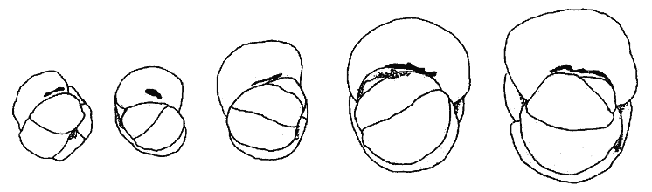 Fig. 92-2. Ontogenetic variability in coiling and apertural morphology among specimens from a station (2677 m depth) in the Norwegian Sea, after Thies (1991). ILLUSTRATIONS: Plate 92 - Cribrostomoides subglobosus forma subglobosus (Cushman) Fig. 1a-b. Recent, Lectotype from the Cushman Collection, Albatross station D3603, 1771 fm, North Pacific, USNM 8219b; Fig. 2a-b. Recent, paralectotype from the Cushman Collection, NERO sta. 160, 1907 fm., North Pacific, specimen with rounded aperture, USNM 8219a; Fig. 3a-b. Recent, specimen from the Brady Collection (from collection of G.O. Sars), Lofoten Islands, Norway, "very deep water", BMNH 1958:11:3:7-12. 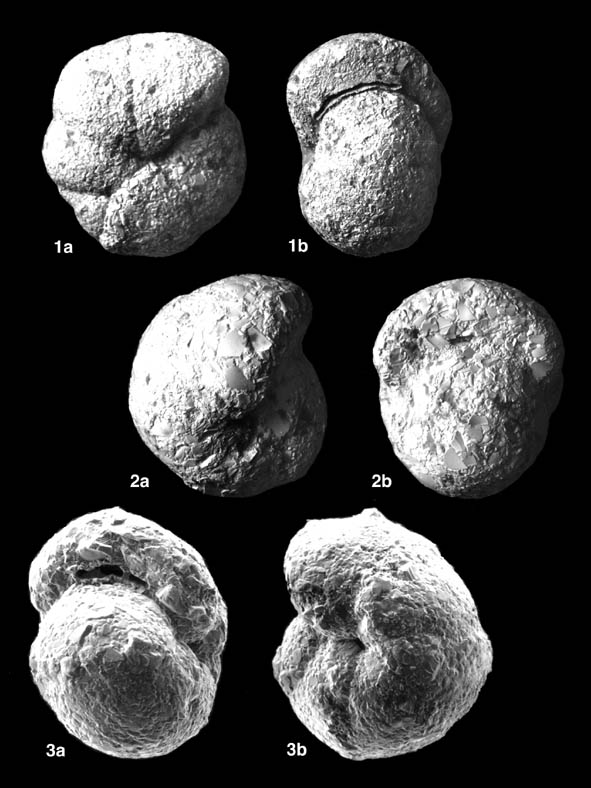
|