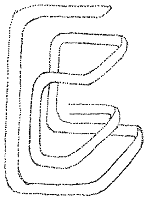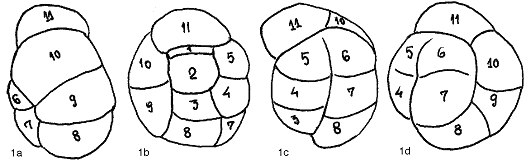
Fig. 101-1. 1a-d. Coiling of the lectotype specimen from the Grzybowski Collection (drawn by Emil Platon) ORIGINAL DESIGNATION: Haplophragmium subturbinatum Grzybowski, 1898 TYPE REFERENCE: Grzybowski, J., 1898. Otwornice pokładow naftonośnych okolicy Krosna. Rozprawy Wydziału Matematyczno-Przyrodniczego, Akademia Umiejętności w Krakowie, serya 2, vol. 33, p. 280, pl. 10, fig. 23. See also: Kaminski, M.A. & Geroch, S., 1993. A revision of foraminiferal species in the Grzybowski Collection. Grzybowski Foundation Special Publication, 1, 239-323, p. 252, pl. 4. fig. 5a-d [Lectotype]. TYPE SPECIMEN: Not originally designated. A specimen corresponding to Grzybowski's original drawing was selected by Prof. S. Geroch from the Grzybowski collection, housed at the Jagiellonian University in Kraków (Grzybowski Collection no. UJ-132-P, 1/30g). This specimen was designated the lectotype by Kaminski & Geroch (1993; pl. 4, fig. 5a-d). TYPE LEVEL: Eocene, Silesian Unit of the Polish Carpathians.. TYPE LOCALITY: The lectotype is from the Potok H-39 well, 82 m, drilled near Krosno, Poland. DIAGNOSTIC FEATURES: Test subglobular, with 10-12 chambers visible on the exterior. Coiling is "streptospiral thalmannamminiform", i.e., the axis of coiling changes abruptly twice at a 90° angle, and thus the direction of coiling doubles back upon itself. The coiling thus appears to be centered about two orthogonal axes. Three to four chambers are added between changes in coiling direction. In immersion, the chambers appear to be oval, and connected to one another by means of a small areal passages. Sutures are flush with the surface of the test. Wall finely agglutinated. Aperture a small areal opening near the base of the last chamber. SIZE: Lectotype is 0.47 mm in diameter. SYNONYMS: None verified. OBSERVED OCCURRENCES: A common species which is widely reported from the Upper Cretaceous and Paleocene of the Alpine-Carpathian region (e.g., Pokorný, 1951; Jurkiewicz, 1967; Pflaumann, 1964; Hanzlíková, 1972; Samuel, 1977; Rögl, 1995; Bąk, 2004). Most authors use this species designation in the sense of Pokorný (1951), but reports must be viewed with caution. We have also found this species in the Paleocene Lizard Springs Formation of Trinidad (see below). KNOWN STRATIGRAPHIC RANGE: Late Senonian to Eocene. BATHYMETRY: Bathyal to abyssal. REMARKS: Grzybowski regarded this species to have "truncatuline" coiling, and his type figure depicts a spherical specimen that may indeed have predominantly trochospiral coiling. However, specimens are present in his collection which also display "thalmannammine" coiling in the sense of Pokorný (1951). We adopt Pokorný's (1951) definition for this species, which we regard as a proper emendation, and selected a lectotype from the Grzybowski collection that best conforms to Pokorný's species concept. Because Pokorný designated H. subturbinatum the type species of the genus Thalmannammina, accepting this definition best serves to preserve the stability of the genus. 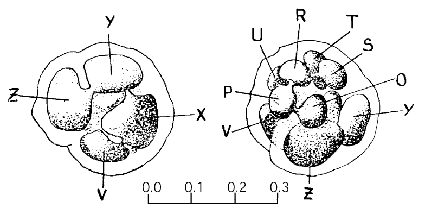 Figure 101-2. Coiling of chambers in Thalmannammina subturbinata, modified after Pokorný (1951) In the current definition of Thalmannammina, Loeblich & Tappan (1987) noted "the plane of coiling may show a sharp change of 90° in later whorls" and illustrated a specimen (as T. subturbinata) that does not resemble T. subturbinata sensu Pokorný. However, Pokorný illustrated specimens that are coiled about two orthogonal axes, with the axis of coiling changing abruptly twice at a 90° angle, thus doubling back on itself 180° (Fig. 101-2). This type of coiling was termed "streptospiral thalmannamminiform" by Platon (1997). This type of coiling is not unique to Thalmannammina, but also occurs among some species of Paratrochamminoides and possibly Glomospira. In our opinion, Loeblich & Tappan's definition of the genus must therefore be emended to take into account the true nature of coiling and the position of the aperture. Charnock & Jones (1990) synonymized Grzybowski's Haplophragmium subturbinatus under the Recent species Recurvoides ex gr. turbinatus (Brady), and at the same time regarded Thalmannammina to be a junior synonym of Recurvoides, a viewpoint which we consider rather extreme. The two genera are fundamentally distinguished by their different modes of coiling (see Fig. 101-3).
The specimens we illustrated as "Recurvoides cf. subturbinatus" from Lizard Springs (Kaminski et al. 1988; pl. 6, figs. 8-9) differ in posessing fewer chambers (5 or 6) and correspond more closely with Recurvoides pentacameratus Krasheninnikov, 1974. ILLUSTRATIONS: Plates 101a,b - Thalmannammina subturbinata (Grzybowski) emend. Pokorný Plate 101a - Fig. 1a-2d. Eocene, specimens from the Grzybowski Collection, Potok H-33, 227 m; Fig. 3. Żywiec, Poland, Żarnówka Stream section, from Geroch collection 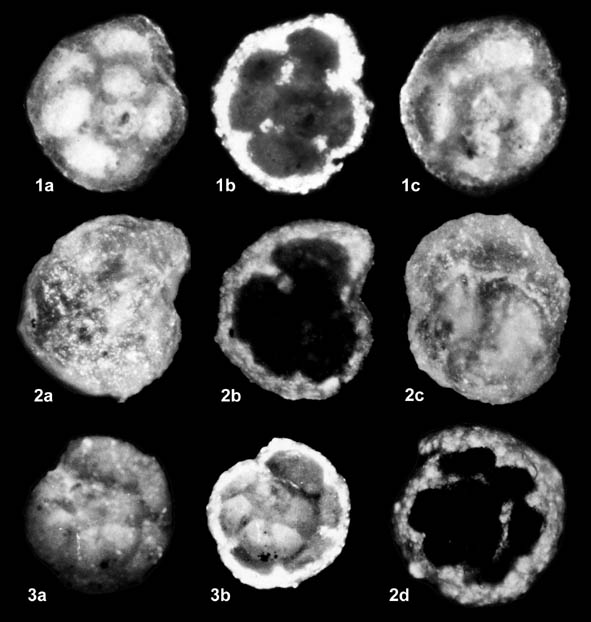
Plate 101b - Fig. 1a-3c. Eocene, syntype specimens from the Grzybowski Collection, Silesian Unit of the Polish Carpathians. 1a-e. Lectotype, Potok H39 well, 82 m. 2a-c. Specimen from the Grzybowski Collection of 1898 labelled "locality unknown"; 3a-c. Paralectotype, Potok H39 well, 82 m. Camera lucida drawings made by Emil Platon. 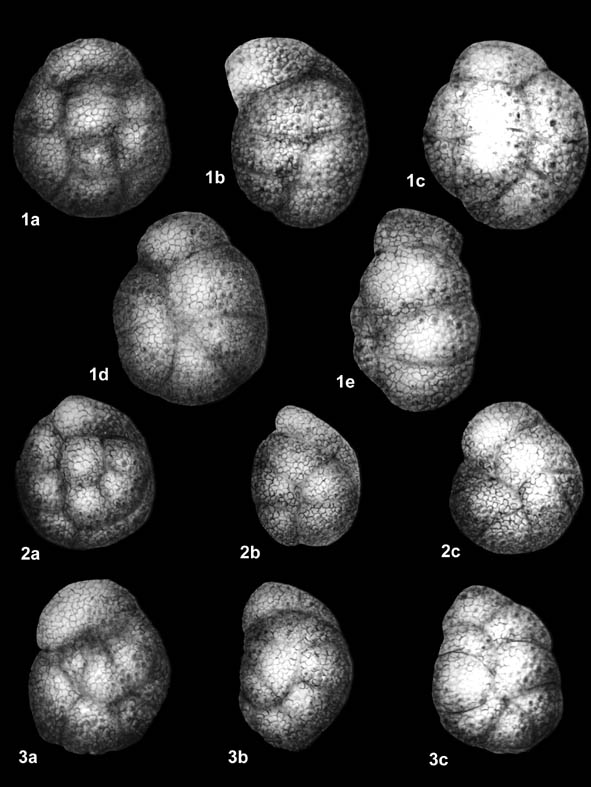
|