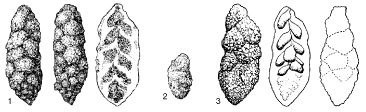
Fig. 117. 1- Holotype of Karreriella horrida, 2 - paratype, from Mjatliuk (1970); 3 - specimen from Geroch (1960) regarded as synonymous by Mjatliuk ORIGINAL DESIGNATION: Karreriella horrida Dabagjan, in Mjatliuk, 1970. TYPE REFERENCE: Mjatliuk, E.V. 1970. Foraminifery flishevykh otlozhenii vostochnykh Karpat (Mel-Paleogen). Trudy VNIGRI 282, 114-115, pl. 5, fig. 9; pl. 33, figs 15, 16a,b. TYPE SPECIMEN: Deposited in the collections of VNIGRI (the All-Union Petroleum Scientific Research-Prospecting Institute), in St. Petersburg. The holotype is catalogued as N433-161. TYPE LEVEL: Selandian, lower part of the Manyavakaya Svita of the Ukrainian Carpathians. TYPE LOCALITY: The Prut River in the village of Mikulinichi, Ukraine. DIAGNOSTIC FEATURES: Test free, elongate, round in cross-section. Test comprised of a short initial trochospiral part of several whorls with 4-6 chambers per whorl, followed by a longer triserial stage of about 4 whorls. A short biserial stage of 1-2 whorls may be present. Chambers in the initial trochospiral part increase rapidly in size. In the triserial stage, chambers increase in size more slowly. The triserial part possesses parallel sides. In larger specimens, the later chambers may be somewhat inflated and irregular. Aperture terminal, on a short neck. Wall medium to finely agglutinated. SIZE: length - 1.05 mm; width - 0.34 mm SUSPECTED SYNONYMS: Plectina cf. apicularis (Cushman). Geroch, S., 1960, Inst. Geol. Bull. 153, p. 60, pl. 6, fig. 9 [Paleogene, Polish Carpathians]. Karreriella apicularis (Cushman). Gradstein, F.M., & Berggren, W.A., 1981. Marine Micropaleontology, 6, pl. 4, figs. 12, 15 [Paleogene, North Sea]. OBSERVED OCCURRENCES: Karreriella horrida was reported by Mjatliuk (1970) from the Paleocene of the Ukrainian Carpathians, but it has also been reported as Plectina cf. apicularis and as Karreriella apicularis from the Paleocene and Eocene of the Polish Carpathians (Geroch, 1960; Jurkiewicz, 1967). It is commonly observed in the Paleogene of the Alpine and Carpathian flysch deposits. Bąk (2004) reported its range as Maastrichtian to Lower Eocene in the Dukla Unit, and noted that it occurs abundantly in the uppermost Maastrichtian. KNOWN STRATIGRAPHIC RANGE: Maastrichtian to Miocene. BATHYMETRY: upper bathyal to abyssal. REMARKS: Mjatliuk (1970) described this species as "Karreriella horrida Dabagjan, n.sp.", without providing any explanation why authorship should be attributed to Dabagjan. We regard the authorship of the species to be that of Mjatliuk, as she obviously provided the description and illustrations. Karrerulina horrida differs from Karrerulina conversa in possessing a multiserial part with more chambers per whorl, and in possessing a well-developed triserial part. The holotype preserved in the VNIGRI collections consists of about eight whorls. The first four whorls are multiserial, followed by a triserial part of 2 1/2 whorls, and then a biserial part of three chambers. The maximum diameter of the test is across the 5-6th whorl and the test gently tapers toward the apex. Mjatliuk (1970) noted that K. horrida resembles Cushman's Gaudrina apicularis from the modern deep ocean, but we now consider G. apicularis synonymous with Karreriella conversa. However, we concede that it is difficult to distinguish immature specimens of K. horrida from K. conversa. Specimens of K. horrida from the Eocene of Poland and from Site 647 are larger and possess more inflated chambers than specimens from the Paleocene of Trinidad. The Trinidad specimens appear to have the chambers in the triserial part arranged in more regular rows than specimens from other localities. ILLUSTRATIONS: Plate 117 - Karrerulina horrida (Mjatliuk) Fig. 1a-b. Paleocene, Manyavskaya Svita, Holotype of Karreriella horrida, Mjatliuk Collection nr. N433-161, 1a; Figs. 2-3. Eocene, Norwegian Sea Site 643, Sample 643-46R-3, 65-69 cm; Figs. 4a-5b. Eocene, Silesian Unit of the Polish Carpathians, specimens labelled "Gaudryina reussi" in the Grzybowski Collection, Potok H-34 well, 320 m; Fig. 6. Eocene, Silesian Unit of the Polish Carpathians, specimen from the Geroch Collection considered by Mjatliuk to be synonymous with K. horrida, Karas stream, near Biecz; Figs. 7-9. Paleocene, Viking Graben, Conoco 211/19-1, 5820 ft; Fig. 10. Paleocene, Viking Graben, Mobil 9/13-3A, 6350-6600'; Fig. 11. Paleocene, Labrador Margin, Gudrid H-55, 8100-8730'. 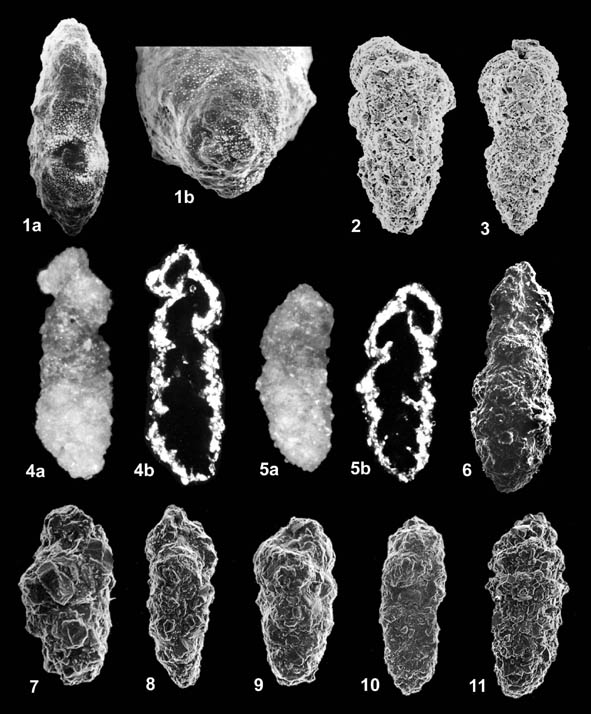
|